

Description
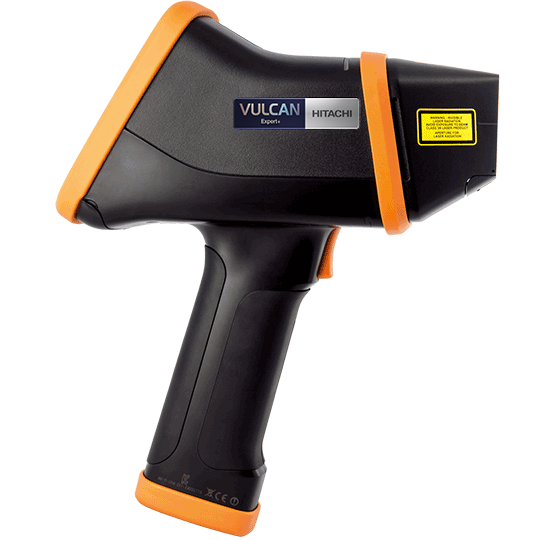
Hitachi Vulcan Expert+ LIBS Analyzer Repair
The Vulcan Expert+ is the full-range model: grade identification and full chemistry across stainless steels, tool steels, low alloy steels and nickel alloys, plus cobalt, copper, lead, tin, titanium and zinc, and aluminum and magnesium as standard rather than as an extension. It is built to the same IP54 and MIL-STD-810G ruggedness as the rest of the line, with sapphire-protected optics and a full working day from one battery. Because it is expected to identify anything put in front of it, a partial degradation is easy to miss — the instrument keeps working on most of what you test and quietly stops being reliable on the rest.
June Company’s certified technicians repair the Vulcan Expert+ for PMI contractors, refinery and power generation QA teams, scrap processors, and manufacturing inspection teams. We diagnose and repair at the board and component level, and every instrument is functionally tested against a known reference sample before it ships back.
Common Vulcan Expert+ problems we fix
- Laser output degradation — weak or inconsistent ablation, showing up as unstable results before it shows up as no result at all.
- Partial alloy-range degradation — specific alloy families becoming unreliable while the bulk of the library still identifies correctly.
- Sapphire measurement window contamination — ablation residue building on the optical window.
- Optical path and fiber contamination — plasma light not reaching the spectrometer cleanly.
- Spectrometer faults — peak positions shifting and element identification becoming unreliable.
- Pre-burn faults — surface cleaning not firing on coated or oxidized samples.
- Camera and targeting faults — the built-in camera no longer documenting or aiming accurately.
- Laser safety interlock and sample sensor faults — the analyzer refusing to fire — working as designed, and repairable.
- Battery and charging faults — the instrument no longer running a full shift on one pack.
- Wi-Fi and ExTOPE cloud connectivity faults — results not reaching the cloud reporting workflow.
FAQs
Most alloys identify fine but one family has gone unreliable. Is that worth sending in? Yes, and sooner rather than later. Partial degradation on a full-range instrument is the failure most likely to reach a report before anyone notices.
Do you work on first-generation Vulcans as well as the plus models? Yes. Tell us which generation you have when you send it, since the hardware differs.
Every repair is backed by a 90-day parts-and-labor warranty, with a firm quote before any work begins. Email us or submit a service request.

Reviews
There are no reviews yet.