
Description
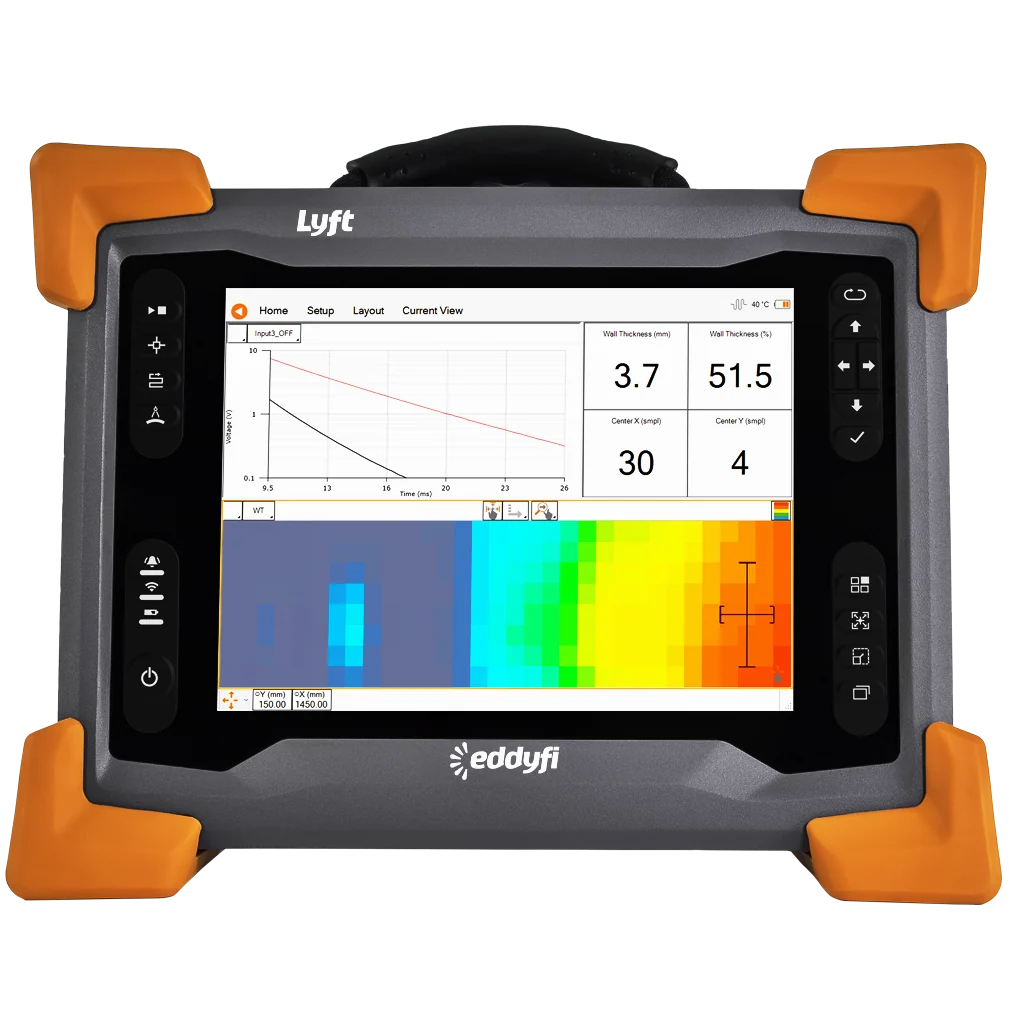
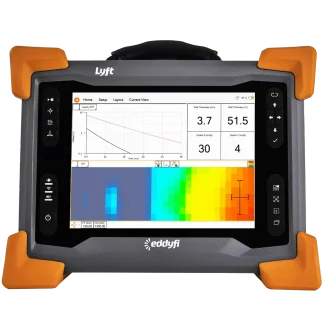
Eddyfi Lyft Pulsed Eddy Current Instrument Repair
June Company repairs the Eddyfi Lyft at the component level — the pulse drive electronics, the probe interface, the acquisition chain and the control boards — rather than swapping modules until something works. Send us the instrument and you get a firm quote before anything is touched, a 90-day parts-and-labor warranty on the work, and NIST-traceable calibration included with most repairs. The evaluation fee is credited to the repair, and most instruments are back out the door in one to three business days.
Knowing the instrument is the difference between a repair and a parts swap. The Lyft measures wall loss through cladding and insulation using pulsed eddy current — it reads the decay of the induced field and converts that into an average thickness across the probe footprint. Two things follow. The result is an average over an area rather than a point measurement, so it is inherently a calibrated inference and anything that shifts the drive or the acquisition timing shifts the answer without breaking anything. And because it is used on corrosion under insulation, the instrument lives outdoors on plant, which puts connector and seal wear near the top of the list. We repair the drive and acquisition electronics at component level and verify against a reference standard.
What is included with every Lyft repair
- Component-level diagnosis and repair — board and component work by certified technicians, not module replacement.
- A firm quote before any work begins — including which subsystem failed and why, so the decision is yours.
- 90-day parts-and-labor warranty on everything we repair.
- NIST-traceable calibration included with most repairs.
- Functional testing against a reference standard before the instrument ships back.
- Evaluation fee credited to the repair — it is not an extra charge on top.
- No forms and no account needed — send it in and we take it from there.
- Out-of-warranty and end-of-support instruments welcome — a large share of what comes through the bench.
Common Lyft problems we fix
- Pulse drive electronics faults — output falling or timing drifting, which biases every thickness reading without raising an error.
- Probe and connector wear — intermittent readings and noise, commonly mistaken for a difficult surface.
- Acquisition timing drift — decay curves no longer fitting cleanly, so averaged thickness moves away from truth.
- Housing, seal and weather damage — enclosure and gasket failures from sustained outdoor use on plant.
- Battery, charging and power faults — shortened runtime, or shutdowns partway through a survey.
- Display and interface failures — dim or unresponsive panels, including faults that make it unusable in gloves.
- Data transfer and software faults — surveys not exporting to the analysis software, or the instrument not being recognised.
FAQs
What does the evaluation involve, and what does it cost me? We bench-test the instrument, identify the failed subsystem and send you a firm price. The evaluation fee is credited to the repair if you go ahead, so the repair costs what the quote says and nothing more.
Thickness readings have shifted against our known reference. What causes that? Drive output or acquisition timing, most often. PEC infers thickness from a decay curve, so anything that changes the pulse or the timing moves the answer while the instrument continues to look healthy.
It lives outdoors on plant. Do you handle the weather damage as well as the electronics? Yes. Enclosure and gasket work is routine on these, and it is worth doing at the same time — a seal that is letting water in will take the electronics out eventually.
Every repair is backed by a 90-day parts-and-labor warranty, with a firm quote before any work begins. Email us or submit a service request.


Reviews
There are no reviews yet.