

Description
Bruker BRAVO Raman Spectrometer Repair
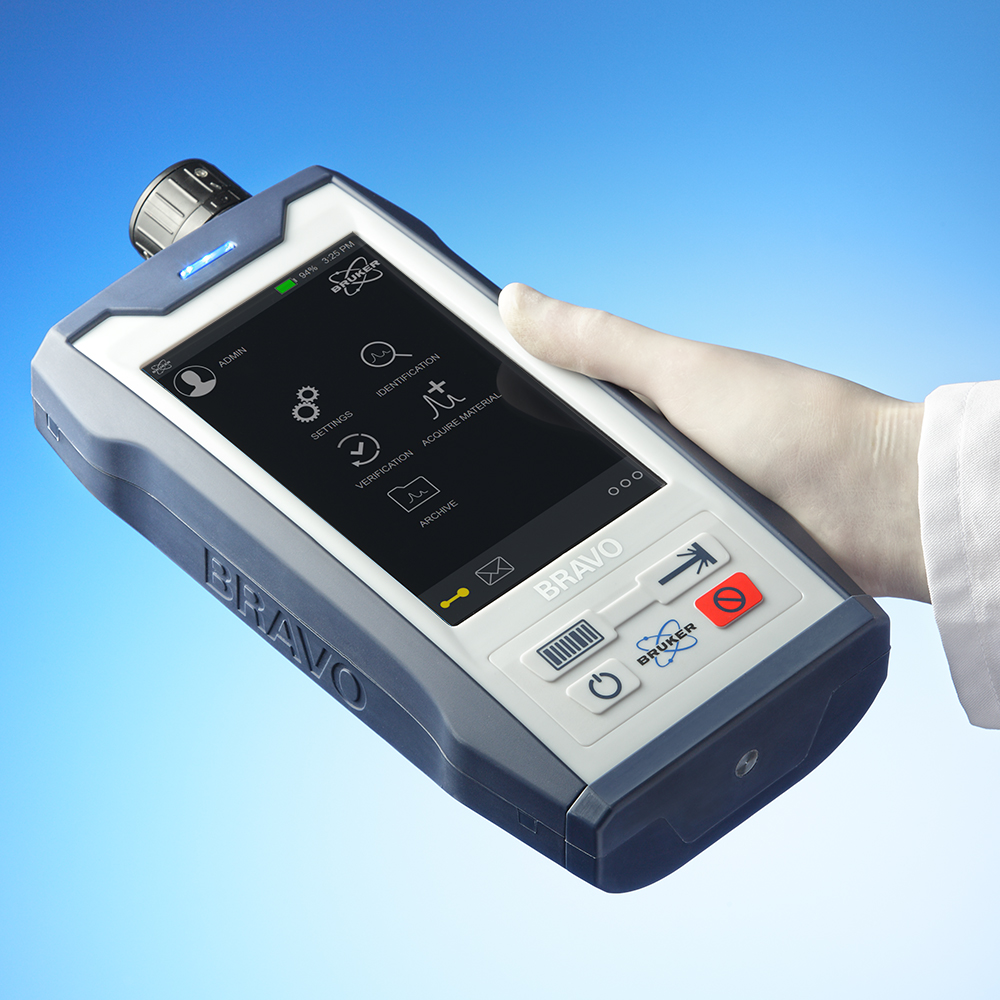
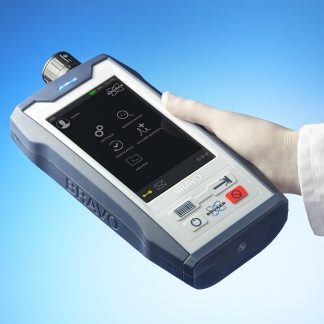
The BRAVO is Bruker’s handheld Raman spectrometer for raw material identification, and it takes an unusual approach to the fluorescence problem. Rather than moving to a single longer excitation wavelength, it carries two temperature-controlled diode lasers, a DuoLaser pair at 785 and 852 nm with Bragg-grating feedback, and uses Sequentially Shifted Excitation to separate the Raman signal from the fluorescence background. Both beams hit the sample in every measurement and are read on different areas of the CCD, giving 300 to 3,200 cm-1 at 10 to 12 cm-1 resolution from a combined output of about 100 mW into a roughly 1 mm spot, with Class 1 laser classification in every operating mode. For repair that design is the whole story: there is more than one laser to keep healthy, and a fault in either changes results in ways easily misread as a sample problem.
June Company’s certified technicians repair the BRAVO for pharmaceutical manufacturers, raw material inspectors, QA and QC teams, and contract manufacturers. We diagnose and repair at the board and component level, and every instrument is functionally tested against a known reference sample before it ships back.
Common BRAVO problems we fix
- Laser output degradation — excitation power falling until spectra get noisy and library match confidence drops.
- Optical alignment drift — throughput falling away after a drop or a shock, with peak positions no longer landing where the library expects.
- Detector degradation — rising noise floor and falling sensitivity, most visible on weak bands and trace components.
- Sapphire window and nose-cone damage — scratching or clouding at the sample interface, which costs signal before it fails outright.
- Dual-excitation imbalance — one excitation source drifting relative to the other, which degrades fluorescence suppression rather than killing the spectrum outright.
- Battery, charging and power faults — shortened runtime, or shutdowns partway through a shift.
- Display and touchscreen failures — dim, dead or unresponsive panels, including digitizer faults that make the interface unusable in the field.
- USB, Wi-Fi and Bluetooth communication faults — results not transferring to the host software, or the instrument not being recognized at all.
- Failed startup self-check or calibration verification — the instrument no longer verifying correctly against its internal reference.
- Housing, seal and ruggedization damage — cracked enclosures and failed gaskets after a drop, which let dust and moisture inside the instrument.
FAQs
Fluorescence suppression has got worse. Is that a software setting? Rarely. On this instrument it usually means the two excitation sources are no longer matched, which is a hardware fault and is measurable on the bench.
Does the instrument need recalibrating after laser work? Yes, and we verify it against reference material before return rather than leaving that to you.
Do you work on other Bruker portable spectrometers? Yes — the ALPHA II, MOBILE-IR II and TANGO II all come through, alongside the handheld XRF line.
Every repair is backed by a 90-day parts-and-labor warranty, with a firm quote before any work begins. Email us or submit a service request.


Reviews
There are no reviews yet.