
Description
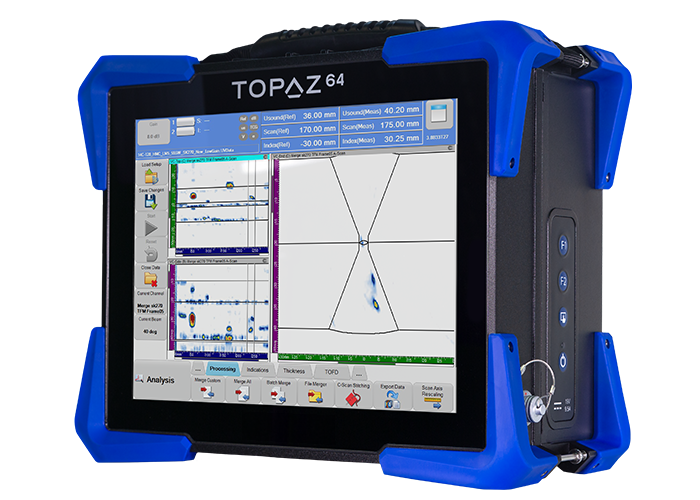
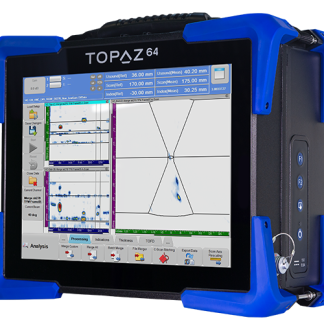
Eddyfi TOPAZ64 Phased Array Flaw Detector Repair
June Company repairs the Eddyfi TOPAZ64 at the component level — the pulser-receiver channels, the array connector, the encoder interface, the display and the control electronics — rather than swapping modules until something works. Send us the instrument and you get a firm quote before anything is touched, a 90-day parts-and-labor warranty on the work, and NIST-traceable calibration included with most repairs. The evaluation fee is credited to the repair, and most instruments are back out the door in one to three business days.
Knowing the instrument is the difference between a repair and a parts swap. Phased array instruments fail in a way that is easy to miss: they keep working. A handful of dead pulser-receiver channels does not stop the instrument or raise an error — it builds the focal law from an incomplete aperture, so the beam is shaped slightly wrong and sensitivity is quietly down. The image still looks like an image. That is why we check channel-by-channel response rather than trusting a power-on self-test, and verify against a calibration block before anything ships. The TOPAZ64 packs 64 parallel channels into a portable body, and that density is exactly why channel-level testing matters on it — the instrument will happily keep imaging with several of them down.
What is included with every TOPAZ64 repair
- Component-level diagnosis and repair — board and component work by certified technicians, not module replacement.
- A firm quote before any work begins — including which subsystem failed and why, so the decision is yours.
- 90-day parts-and-labor warranty on everything we repair.
- NIST-traceable calibration included with most repairs.
- Functional testing against a calibration block before the instrument ships back.
- Evaluation fee credited to the repair — it is not an extra charge on top.
- No forms and no account needed — send it in and we take it from there.
- Out-of-warranty and end-of-support instruments welcome — a large share of what comes through the bench.
Common TOPAZ64 problems we fix
- Dead or weak pulser-receiver channels — the fault that matters most and shows least — a handful of failed channels distorts the focal law rather than stopping the instrument.
- Array connector wear and damage — the highest-wear part on any phased array instrument — bent or eroded contacts drop channels without any warning on screen.
- Encoder and positional faults — scans that look clean but are geometrically wrong, so an indication is reported in the wrong place.
- Display and touchscreen failures — dim, dead or unresponsive panels, including digitizer faults that make it unusable in gloves.
- Battery, charging and power faults — shortened runtime, or shutdowns partway through a scan.
- Housing, seal and ruggedisation damage — cracked enclosures and failed gaskets after a drop, letting moisture and dust inside.
- Data transfer and software faults — scans not exporting to the analysis software, or the instrument not being recognised at all.
FAQs
What does the evaluation involve, and what does it cost me? We bench-test the instrument, identify the failed subsystem and send you a firm price. The evaluation fee is credited to the repair if you go ahead, so the repair costs what the quote says and nothing more.
A few channels are dead but it still produces images. Does that matter? Yes, more than most people expect. The instrument keeps working and the image keeps looking plausible, but the focal law is being built from an incomplete aperture, so sensitivity and beam shape are quietly wrong. It is the single most common thing we find.
The array connector is worn. Is that a whole-instrument repair? No. The connector is the highest-wear part on these instruments by a wide margin, and it is repairable on its own. It is also the most common cause of channels that come and go.
Every repair is backed by a 90-day parts-and-labor warranty, with a firm quote before any work begins. Email us or submit a service request.


Reviews
There are no reviews yet.